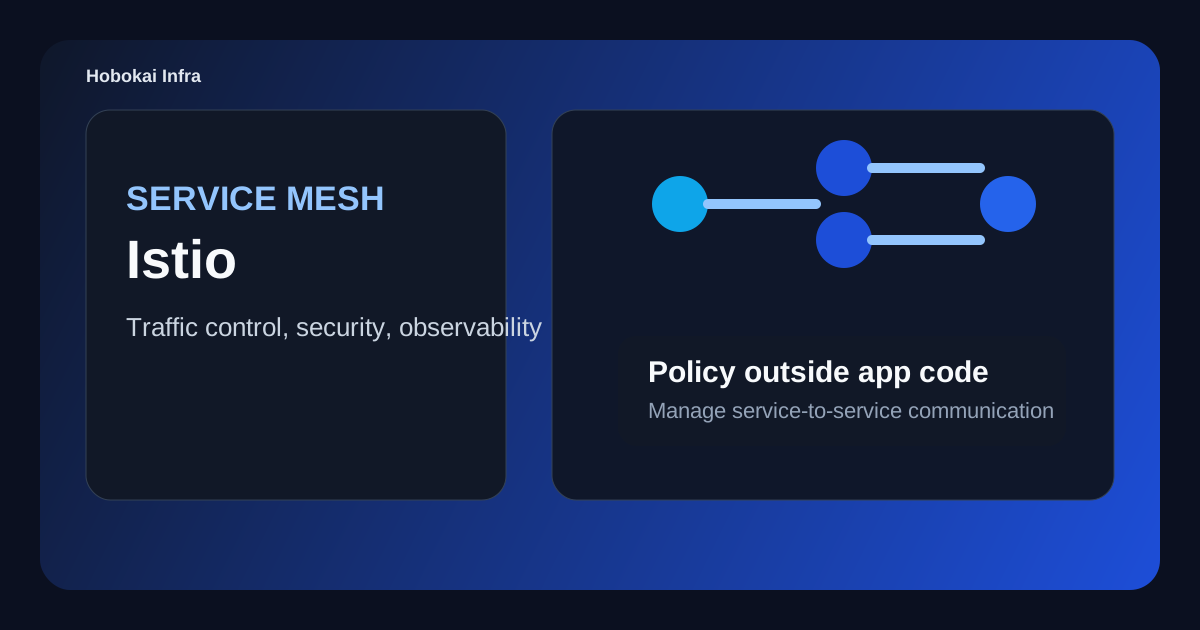
Istio and HPA are often mentioned in Kubernetes discussions, but they solve very different problems. HPA adjusts Pod counts automatically based on load. Istio is a service mesh for controlling, securing, and observing service-to-service traffic.
In other words, HPA answers “how many Pods should be running?” while Istio answers “how should services talk to each other, how should that traffic be governed, and how should it be observed?”
This post covers three things.
- what Istio is
- how it differs from core Kubernetes resources
- why teams use it for traffic control, security, and observability
The key idea is this: Istio is not an autoscaling tool. It is a service mesh for managing service-to-service communication.
What Istio is
Istio is a service mesh that runs on top of Kubernetes and gives you more control over how services communicate. It goes beyond simply connecting Pods. It helps define routing behavior, apply communication policies, and collect shared telemetry.
Typical examples include:
- service-to-service request routing
- canary rollouts and traffic splitting
- mTLS between services
- latency, error rate, and request path visibility
So a useful mental model is that Istio is a layer for handling network policy and observability outside the application code itself.
How Istio differs from HPA
This distinction is the fastest way to make the overall picture clearer.
- HPA: automatically adjusts Pod counts
- Istio: controls and observes service-to-service traffic
For example:
- increasing replicas from 2 to 6 because CPU is high -> HPA
- sending only 10 percent of traffic to a new version -> Istio
- enforcing TLS between services -> Istio
- observing request latency and failure rates -> Istio
So these are not competing tools. They work at different layers.
Why core Kubernetes features may not be enough
Core Kubernetes features such as Service, Deployment, Ingress, and HPA already cover a lot. But as the number of services grows and service-to-service calls become more complex, traffic requirements also become more detailed.
For example, teams often want to:
- send only part of traffic to a new version
- enforce stricter protection between internal services
- observe which service call path is slow
- manage retries, timeouts, and circuit-breaking outside the app code
That is the point where a service mesh starts becoming relevant.
How Istio is usually structured
At a beginner level, it is often enough to think in two parts:
- control plane: manages policy and configuration
- data plane: applies those policies to real traffic
In many explanations, Envoy sidecars appear as part of that story. A proxy sits next to workloads and handles routing, security, and telemetry on the traffic path.
So Istio is largely about moving common network behavior out of the application and into a shared layer.
What teams use Istio for
1. Traffic control
Istio is often used for version-based traffic splitting, header-based routing, canary rollouts, and blue-green delivery.
For example:
- 90 percent of traffic to v1
- 10 percent of traffic to v2
That lets teams validate new versions gradually.
2. Security
Istio can apply mTLS between services and define which services are allowed to talk to which others.
That means internal traffic is treated more deliberately instead of assuming that everything inside the cluster is automatically trusted.
3. Observability
Istio makes it easier to collect common visibility into request paths, latency, error rates, and retries.
As service count grows, it becomes much harder to see where slowness or failure really starts. This is one reason service meshes come up in larger systems.
How Istio differs from Service and Ingress
This is another common point of confusion.
- Service: stable access to a Pod set
- Ingress: decides which Service should receive incoming external HTTP traffic
- Istio: adds finer-grained policy, security, and observability for traffic behavior
So Service and Ingress sit at the center of core Kubernetes networking, while Istio adds a more advanced operational layer on top of that.
Does every cluster need Istio
No. Small or simple systems can often do very well with core Kubernetes features alone.
Istio becomes more meaningful when:
- there are many microservices
- service call paths are complex
- traffic-split delivery matters
- security and observability should be handled consistently across services
If the system is simple, Istio can add more operational complexity than value.
Common misunderstandings
1. Istio handles autoscaling
No. Autoscaling is usually the job of HPA.
2. Istio replaces Service and Ingress completely
Usually not. It works alongside core Kubernetes networking resources.
3. Istio is always the right next step
Not necessarily. The operational cost needs to match the system complexity.
A good beginner exercise
- create two simple services with one calling the other
- apply an Istio routing rule that splits traffic between versions
- observe how latency and errors become visible
- compare that with HPA so the difference between scaling and traffic control is obvious
That exercise makes it much clearer that HPA and Istio are not two versions of the same feature. They solve different operational problems.
FAQ
Q. Should I choose Istio or HPA?
Usually not. They serve different purposes and can be used together.
Q. Is Istio the same thing as an ingress controller?
No. Some entry-point behavior can look similar, but Istio is a broader service mesh layer.
Q. Should beginners learn Istio first?
It is usually much easier after core ideas like Service, Deployment, Ingress, and HPA already feel comfortable.
Read Next
- If Pod autoscaling is the part you want next, pair this with Kubernetes HPA Guide.
- If you want to revisit the basic traffic path first, Kubernetes Service Guide and Kubernetes Ingress Guide are strong companions.
While AdSense review is pending, related guides are shown instead of ads.
Start Here
Continue with the core guides that pull steady search traffic.
- Middleware Troubleshooting Guide: Redis vs RabbitMQ vs Kafka A practical middleware troubleshooting guide for developers covering when to reach for Redis, RabbitMQ, or Kafka symptoms first, and which problem patterns usually belong to each tool.
- Kubernetes CrashLoopBackOff: What to Check First A practical Kubernetes CrashLoopBackOff troubleshooting guide covering startup failures, probe issues, config mistakes, and what to inspect first.
- Kafka Consumer Lag Increasing: Troubleshooting Guide A practical Kafka consumer lag troubleshooting guide covering what lag usually means, which consumer metrics to check first, and how poll timing, processing speed, and fetch patterns affect lag.
- Kafka Rebalancing Too Often: Common Causes and Fixes A practical Kafka troubleshooting guide covering why consumer groups rebalance too often, what poll timing and group protocol settings matter, and how to stop rebalances from interrupting useful work.
- Docker Container Keeps Restarting: What to Check First A practical Docker restart-loop troubleshooting guide covering exit codes, command failures, environment mistakes, health checks, and what to inspect first.
While AdSense review is pending, related guides are shown instead of ads.