How Does an LLM Predict the Next Token? The Core Idea Beginners Should Learn First
One of the best first questions to ask about LLMs is this: how does the model actually generate text? On the surface it can look as if the system already knows the full answer and simply writes it down. But the real mechanism is both simpler and more important.
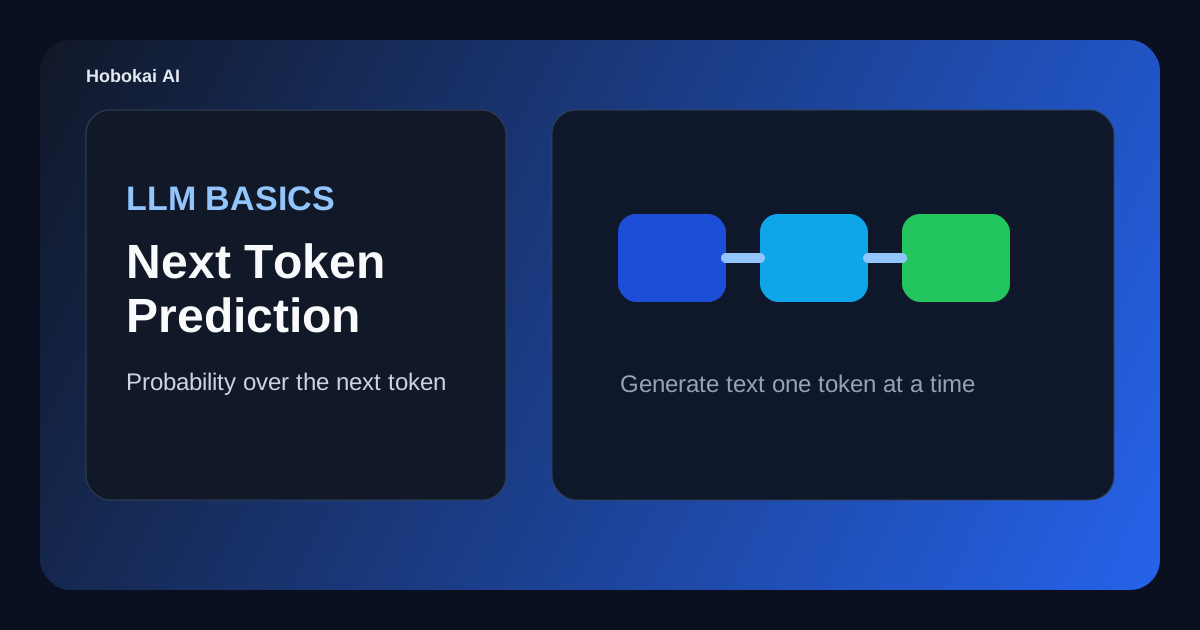
At its core, an LLM usually does not produce a complete sentence in one step. It looks at the input and the tokens generated so far, predicts the probability of the next token, selects one, and repeats that process again and again. Once you understand that idea, a lot of other behavior starts to make more sense: why prompts matter so much, why two runs can differ, and why hallucinations happen.
This guide covers:
- what an LLM is really predicting
- why probability-based generation matters
- why settings like temperature and top-p exist
The main takeaway is this: an LLM is not a machine that retrieves a finished sentence. It is a model that keeps extending text by predicting the next token from a probability distribution.
An LLM predicts tokens, not whole words
People often say an LLM predicts the “next word,” which is good enough for a simple explanation. More precisely, it predicts the next token.
A token is not always the same thing as a word. It may be:
- a full word
- part of a word
- punctuation
- a text fragment that includes spacing
For example, a sequence such as Hello, ,, and world may be treated as separate pieces.
That means the model is not really assembling complete thoughts in one shot. It is working with smaller units that get chained together into larger text.
Once that clicks, it becomes easier to see why small prompt differences can change the result and why output can vary from one run to another.
Next-token prediction is a probability problem
The model usually does not consider only one possible next token. It assigns probabilities across many candidates based on the context it has so far.
Suppose the input is:
The capital of France isIn that context, Paris is likely to receive a high probability. But the model is not simply following a hardcoded rule that says “France -> Paris.” It is working through a probability distribution over possible continuations.
That is one reason LLMs behave differently from strict rule-based systems. Rule-based software tends to produce the same output every time for the same matched condition. LLMs operate through ranked likelihoods and selection choices.
Repeating this process creates full text
At a high level, generation looks like this:
- read the tokens so far
- calculate probabilities for the next token
- select one token
- append it to the sequence
- repeat
So even a long paragraph is really the result of many small prediction steps chained together.
input context -> next token -> updated context -> next token -> repeatThis is why it is perfectly normal for the same prompt to produce slightly different answers. Each step involves choices shaped by the model and the sampling settings.
This is also why prompts matter so much
A prompt is not just a request in plain language. It is input that changes the probability distribution of future tokens. If you rewrite the instruction, add an example, or clearly define the output format, you change what the model sees as the most likely continuation.
Compare these two prompts:
Summarize this document.Summarize this document in 3 bullet points, and keep each bullet under 20 words.The second prompt gives the model more constraints about length, structure, and style. That often narrows the next-token distribution in a helpful way. This is part of why the Prompt Engineering Guide matters in practice.
What do temperature and top-p control?
If the model predicts probabilities for many candidate tokens, the next question is how one of those candidates gets chosen. That is where settings like temperature and top-p come in.
Temperature
Temperature changes how sharp or spread out the distribution behaves.
- lower temperature: more conservative and predictable
- higher temperature: more varied and sometimes more surprising
One common misconception is that a higher temperature makes the model smarter. It does not. It can increase variation, but not automatically correctness.
top-p
top-p limits selection to the most probable set of candidates whose cumulative probability reaches a threshold. In simpler terms, it removes a lot of unlikely options before sampling happens.
Both settings are really about how the system chooses from the next-token distribution.
Why do answers vary, and why do hallucinations happen?
This mechanism helps explain both variation and hallucination. An LLM is not a database that directly retrieves facts in a guaranteed way. It generates plausible continuations from context.
That means trouble is more likely when:
- the prompt is ambiguous
- the model lacks grounded evidence
- the desired format is underspecified
- plausible wording is easier to generate than verified wording
So hallucinations are not just random lies. They are tied to the fact that the system is generating likely continuations, sometimes without enough grounding to keep those continuations factual. That is why practical systems often combine prompting with retrieval and verification, as discussed in the AI Hallucination Reduction Guide and the RAG Guide.
Why does this idea matter in practice?
Once you understand next-token prediction, several important behaviors become easier to reason about.
- why prompt wording strongly affects output
- why repeated runs can differ
- why temperature should vary by task
- why evaluation matters instead of relying on impressions
For example, a customer support workflow may need conservative settings and strong format control. A brainstorming workflow may benefit from more variation. The right setup depends on the job.
Common misunderstandings
1. The model forms a complete answer first and then reveals it token by token
It may look that way, but the real mechanism is much closer to repeated next-token selection.
2. Higher temperature means better creativity, so it is always better
Not necessarily. More variation can help in some tasks, but it can hurt reliability and format compliance in others.
3. Wrong answers happen only because the training data lacked the fact
Not always. Probability-based generation can still produce plausible but incorrect token sequences.
FAQ
Q. If the model predicts only the next token, how can it produce long explanations?
Because many small prediction steps chained together can still create long, structured responses.
Q. Are tokens exactly the same as words?
No. They can be smaller fragments, punctuation, or other text pieces.
Q. Does understanding this help with prompting?
Yes. Once you know prompts change next-token probabilities, prompt design becomes much more intuitive.
Read Next
- If you want more control over output quality and structure, continue with the Prompt Engineering Guide.
- If you want to see how external knowledge gets injected into the model’s context, the RAG Guide is the natural follow-up.
- To measure whether those changes actually improve results, pair this with the LLM Evaluation Guide.
Start Here
Continue with the core guides that pull steady search traffic.
- Middleware Troubleshooting Guide: Where to Start With Redis, RabbitMQ, or Kafka A practical middleware troubleshooting hub covering how to choose the right first branch when systems using Redis, RabbitMQ, and Kafka show cache drift, queue backlog, or consumer lag.
- Kubernetes CrashLoopBackOff: What to Check First A practical Kubernetes CrashLoopBackOff troubleshooting guide covering startup failures, probe issues, config mistakes, and what to inspect first.
- Technical Blog SEO Checklist for Astro: What to Fix Before You Wait for Traffic A practical Astro SEO checklist for technical blogs covering deployed-site checks, robots.txt, sitemap, canonical, hreflang, structured data, page-role metadata, noindex decisions, and verification commands.
- Canonical and hreflang Setup for Multilingual Blogs: What to Check and What Breaks A practical guide to canonical and hreflang setup for multilingual blogs, covering self-canonicals, reciprocal hreflang clusters, x-default, category pages, rendered HTML checks, and the mistakes that make one language version suppress another.
- OpenAI Codex CLI Setup Guide: Install, Auth, and Your First Task A practical OpenAI Codex CLI setup guide covering installation, sign-in, the first interactive run, Windows notes, and the safest workflow for your first real task.