AI
Browse AI posts covering agents, model comparisons, local LLMs, chatbots, and RAG workflows.
Popular in Other Topics
- Middleware Troubleshooting Guide: Where to Start With Redis, RabbitMQ, or Kafka Dev
- Kubernetes CrashLoopBackOff: What to Check First Infra
- Technical Blog SEO Checklist for Astro: What to Fix Before You Wait for Traffic Web
- Canonical and hreflang Setup for Multilingual Blogs: What to Check and What Breaks Web
- OpenAI Codex CLI Setup Guide: Install, Auth, and Your First Task Dev
No matching posts found.
- AI
AI Agent Guide: How Goal-Driven Systems Differ from Chatbots
A practical guide to AI agents covering what they are, how they differ from chatbots, how planning-memory-tools-feedback loops work, and when agents are useful versus unnecessary.
- AI
AI Agent Skills Guide: How Agents Use Search, Code, and File Tools
A practical guide to AI agent skills and tool use, covering search, code execution, file access, function calling, and the most common design mistakes in real systems.
- AI
LLM Benchmark Guide: How to Compare Models for Coding, Cost, and Quality
A practical guide to comparing LLMs across coding ability, reasoning, cost, context window, latency, and workflow fit so teams can choose models more realistically.
- AI
Ollama Local LLM Guide: What to Know Before Running Models on Your Own Machine
A practical guide to using Ollama for local LLMs, covering installation, first runs, Modelfile basics, the local API, editor workflows, and when local models make more sense than hosted APIs.
- AI
Supabase RAG Chatbot Guide: OpenAI, pgvector, and Private Data Search
A practical guide to building a RAG chatbot with Supabase and OpenAI. Learn how pgvector fits into ingestion, retrieval, prompt design, and the mistakes that make internal-data chatbots unreliable.
- AI
How to Build a Slack AI Chatbot with OpenAI API and Node.js
A practical tutorial for building a Slack chatbot with OpenAI API and Node.js. Learn the basic architecture, Slack app setup, prompt handling, and where a custom bot works better than generic AI tools.
- AI
Vector Database Guide: When Semantic Retrieval Needs More Than Keyword Search
A practical guide to vector databases covering how they work with embeddings, why RAG systems use them, when they help more than a normal database, and when they are unnecessary.
- AI
Tool Calling Guide: How LLMs Use APIs, Functions, and Safe Actions
A practical guide to tool calling covering what it is, how it differs from chat and direct API integration, and how to design safer, more reliable tool-enabled AI systems.
- AI
Temperature vs Top-p: How to Control LLM Variety Without Guessing Blindly
A practical guide to temperature vs top-p covering what each control changes, how they differ, and how to choose settings for structured tasks, factual tasks, and creative tasks.
- AI
Prompt Engineering Guide: Designing Inputs That Lead to Better AI Answers
A practical guide to prompt engineering covering role, context, constraints, examples, iteration, and the point where you need RAG or tool calling instead of prompting alone.
- AI
RAG Guide: The Most Practical Way to Help LLMs Use External Knowledge
A practical guide to RAG covering when it is useful, how chunking, embeddings, retrieval quality, prompt grounding, citations, and evaluation fit together, and where RAG is not the right tool.
- AI
How Does an LLM Predict the Next Token? The Core Idea Beginners Should Learn First
A practical beginner-friendly guide to how LLMs predict the next token, why probability-based generation matters, and why settings like temperature and top-p affect output behavior.
- AI
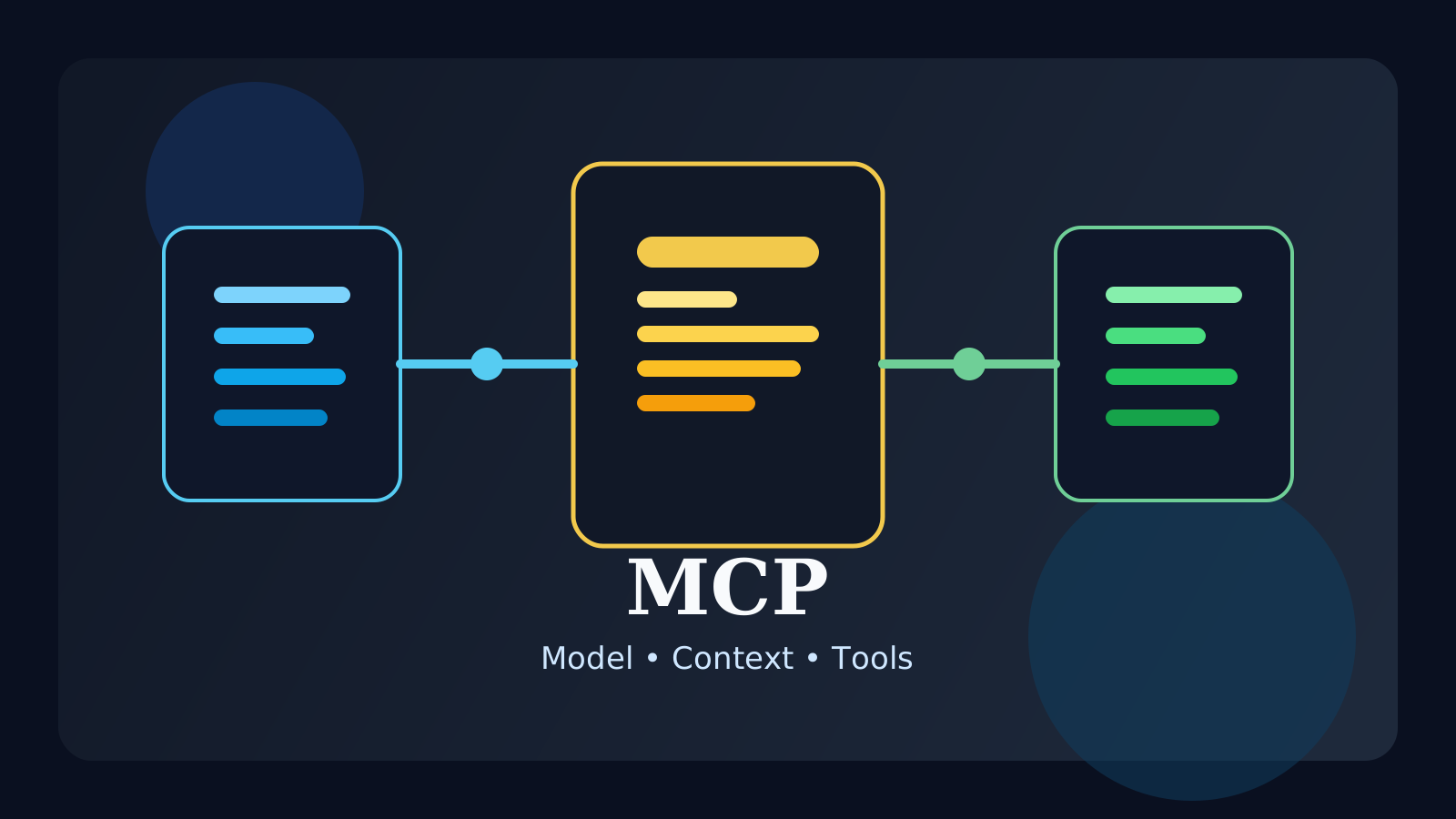
MCP Guide: Understanding the Standard Layer Between AI Apps and External Systems
A practical beginner guide to MCP covering the host-client-server model, the roles of tools, resources, and prompts, and how MCP differs from APIs, RAG, and agents.
- AI
LLM Evaluation Guide: How to Measure and Improve AI Output Quality
A practical beginner-friendly guide to what LLM evaluation is, what to measure, and how to combine human review with repeatable metrics as your AI system evolves.
- AI
Fine-Tuning vs RAG: How to Choose Between Behavior Tuning and Knowledge Retrieval
A practical guide to fine-tuning vs RAG covering what each approach changes, which problems each one fits, and how to decide what to try first in real AI products.
- AI
Inference vs Training: Why Model Learning and Model Serving Are Different Jobs
A practical guide to inference vs training covering what each one does, how fine-tuning fits, and why product teams usually spend more time thinking about inference systems.
- AI
Embeddings Guide: Why AI Turns Text Into Vectors and What That Enables
A practical guide to embeddings covering why text is turned into vectors, how semantic similarity becomes measurable, and how embeddings support search, recommendation, clustering, classification, and RAG.
- AI
Context Window Guide: What an LLM Can Actually See in One Request
A practical beginner-friendly guide to what a context window is, why token limits matter, what breaks in long chats and long documents, and how teams handle those limits in real products.
- AI
AI Workflow Orchestration Guide: Why Flow Design Matters More Than One Model
A practical guide to AI workflow orchestration covering routing, retrieval, tool calling, validation, fallback, and evaluation, and why model quality alone is never enough in production.
- AI
AI Latency Optimization Guide: The Most Practical Order for Making Responses Faster
A practical guide to AI latency optimization that breaks delay into prompt size, retrieval, model routing, tool calling, caching, streaming, and validation, then shows the best order for reducing response time in production.
- AI
How to Reduce AI Hallucinations: A Practical System Design Guide
A practical guide to reducing AI hallucinations with better prompting, RAG, tool calling, structured output, validation, and evaluation instead of relying on model quality alone.
- AI
Claude Cowork Guide: Assign Tasks to Claude from Your Phone
A practical guide to Claude Cowork and the Assign tasks from anywhere feature, covering how it works, setup requirements, real use cases, and the main limitations to know.