Once people spend even a little time around AI systems, embeddings start appearing everywhere. But the first explanation is often too thin to be useful:
“They turn text into numbers.”
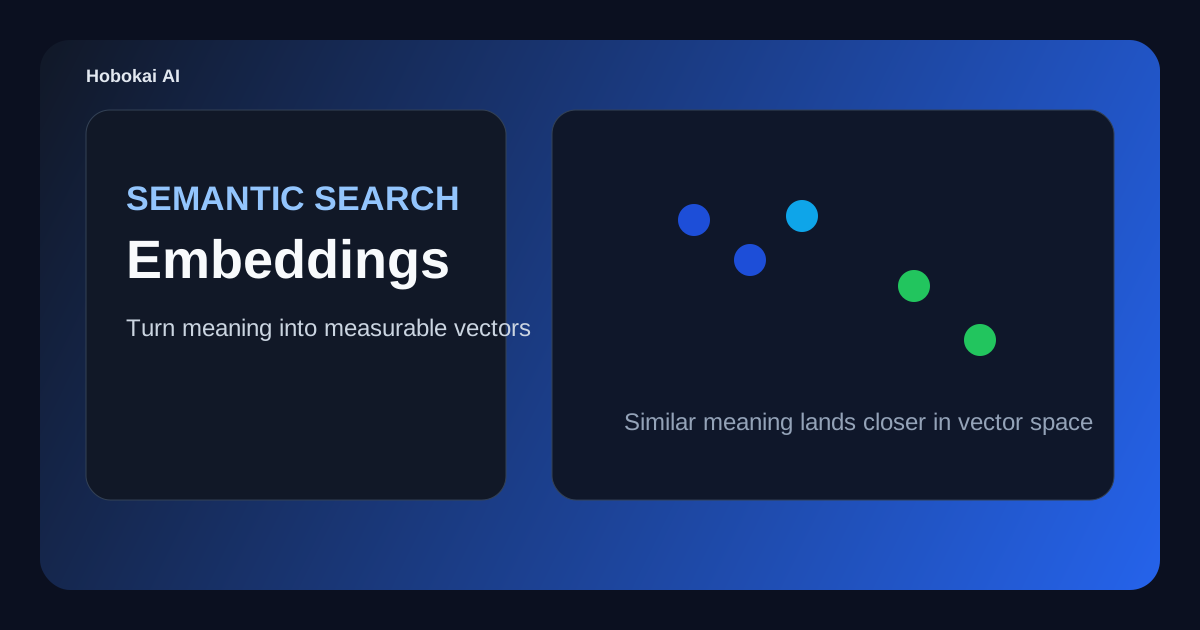
That is not wrong, but it misses the real point. What matters is not that text becomes numbers. What matters is that semantically similar text is represented as vectors that tend to land closer together in a shared space.
That is why embeddings are much more than a technical encoding trick. They are the representation layer that makes semantic search, recommendation, clustering, classification, and RAG retrieval practical.
The short version looks like this:
- Embeddings represent text as fixed-length vectors.
- Those vectors are not just IDs. They encode some degree of semantic similarity.
- That makes it possible to compare questions to documents, documents to documents, and users to items by similarity.
- Embeddings are especially important in semantic search and RAG, but they are also useful in recommendation, clustering, and classifier pipelines.
- Adding embeddings alone does not magically make a model smarter. They are valuable because of how they are used inside a larger system.
This guide explains embeddings in that practical sense.
Embeddings are a way to make meaning computationally comparable
An embedding is a fixed-length vector representation of text, images, items, or other data. The important property is not the vector itself. It is that the vector is designed so that meaning-related relationships are reflected, at least approximately, in vector space.
For example:
- “cat” and “dog” may land relatively close
- “cat” and “database” may land much farther apart
That is why embeddings are not just numeric labels or hashes. They are better thought of as a representation layer where similarity and distance can carry semantic signal.
So the central question is not “what numbers did this sentence become?” It is “what do distance and direction between these vectors tell us about the underlying meanings?”
Why text gets turned into vectors
Raw strings are not naturally easy for computers to compare by meaning. Exact text matching is useful, but it often breaks as soon as phrasing changes.
For example:
- “I forgot my password”
- “How do I reset my login password?”
These are close in meaning for a person, but not necessarily close in raw token matching.
Once text becomes vectors, systems can compute things like:
- how similar two sentences are
- which document is closest to a question
- which items belong in a similar cluster
So embeddings are really a way to convert text into a form where semantic relatedness becomes computable.
What it means for vectors to be close
This is one of the most important intuitions to build early.
Each text becomes a vector, and the similarity or distance between those vectors acts as a rough proxy for semantic closeness.
In simple terms:
- close vectors -> likely more related in meaning
- distant vectors -> likely less related in meaning
This is not perfect human understanding. But it is powerful enough to make large retrieval and organization systems much better.
In practice, people often think in terms like cosine similarity. The exact metric matters less than the practical idea: the system can compare meanings numerically instead of relying only on exact wording.
How embedding search differs from keyword search
Keyword search is usually strong when exact or near-exact token matching matters. Embedding search is strong when wording differs but intent or meaning stays close.
That means:
- keyword search is strong for exact names, identifiers, and literal matches
- embedding search is strong for semantic similarity and natural-language queries
So the two approaches are usually complements, not enemies.
In many production systems:
- exact codes, product names, or error strings are better served by keyword search
- natural-language questions and similar-document retrieval are better served by embedding search
That is why hybrid search, which combines both, is so common in practice.
Where embeddings are most commonly used: semantic search
The most visible use case is semantic search.
Here, the goal is to retrieve documents that are similar in meaning even when the wording differs.
For example, a user may ask:
- “I forgot my password”
- “How can I recover my account login?”
and still find a document titled:
- “How to reset your login password”
This kind of search is extremely useful in customer support, internal knowledge bases, documentation search, and product-help systems.
In other words, semantic search is less about exact word overlap and more about whether the query and the document are about the same thing.
Another major use case: recommendation
Embeddings also show up frequently in recommendation systems, because they make it easier to compare items by meaning or behavior.
Examples include:
- recommending articles similar to ones a user already liked
- suggesting products that are close in theme or description
- grouping users or items by behavioral similarity
The important part is that recommendation often needs more than category matching. It benefits from something closer to contextual similarity.
That is where embeddings become useful: they help systems capture “this feels similar” even when the literal words are different.
Embeddings also help with clustering and classification
Embeddings are not only for retrieval. They are also useful as a representation layer for organizing and labeling data.
Examples include:
- grouping customer tickets by semantic similarity
- clustering reviews by topic
- creating better features for downstream classifiers
- organizing document collections by meaning rather than file path
In these cases, embeddings are less like the final answer and more like an intermediate layer that makes later operations easier and more robust.
That is why embeddings are often part of a pipeline rather than a product feature users see directly.
Embeddings are a core part of many RAG retrieval layers
One of the most common modern use cases is RAG.
In a typical RAG setup:
- documents are split into chunks
- each chunk receives an embedding
- the user question also receives an embedding
- the system retrieves the nearest chunks
- those chunks are passed to the model as context
This makes embeddings one of the key components of the retrieval layer that feeds the model.
That is why the RAG Guide connects so naturally here. RAG is the architecture that retrieves external knowledge, and embeddings are often the representation layer that helps retrieval find the right knowledge in the first place.
Embeddings do not solve everything by themselves
This is where many beginner expectations go wrong. Adding embeddings does not automatically make a system good.
If embedding-based retrieval feels weak, the real problem may be:
- poor chunking strategy
- missing metadata filters
- relying on semantic search where exact matching matters more
- too many or too few retrieved results
- low-quality source documents
So embeddings are powerful, but they only become useful when paired with solid system design.
That is why it is often more accurate to say: embeddings are a strong representation layer, not a complete retrieval solution by themselves.
In practice, how embeddings are used matters more than the fact that they exist
Once embeddings are part of a system, the important design questions usually become:
- what unit should be embedded?
- should queries and documents use the same representation strategy?
- should semantic search be combined with keyword search?
- should there be a similarity threshold?
- is reranking needed after initial retrieval?
In other words, the real product question is not “did we call an embeddings API?” It is “how are these vectors being turned into an actually useful retrieval or ranking pipeline?”
That is why embeddings are best understood as part of search, recommendation, or RAG workflows rather than as an isolated concept.
Embeddings and LLMs are related, but not the same thing
A common beginner question is whether embeddings are basically the same as an LLM. They are connected, but they play different roles.
- generation models mainly help produce text
- embedding models mainly help represent and compare text
So embeddings are usually more valuable in retrieval, ranking, grouping, and recommendation layers than in direct response generation.
The distinction matters because it helps avoid expecting embeddings to solve the wrong problem.
A useful learning order goes from generation to retrieval
Embeddings often make the most sense in this sequence:
That order moves naturally from “how generation works” to “how systems retrieve the right knowledge before generation.”
Common misunderstandings
1. Embeddings are just numeric IDs
No. Their value comes from the geometry of the vector space carrying similarity information.
2. Adding embeddings automatically makes an LLM more accurate
Not by itself. Embeddings help representation and retrieval. They do not automatically guarantee better generation quality.
3. Embedding search is always better than keyword search
No. Exact matching still matters in many tasks, especially with identifiers, codes, and literal names.
4. If two vectors are close, they must mean exactly the same thing
Not necessarily. Closeness is a useful approximation, not a guarantee of identical meaning.
FAQ
Q. Are embeddings the same as an LLM?
No. They are related, but their roles differ. Embeddings mainly help representation and retrieval, while LLMs are usually used more directly for generation.
Q. If two texts have similar embeddings, can I assume they mean the same thing?
Not exactly, but they often have a higher chance of being semantically related than unrelated texts do.
Q. Do I need embeddings for RAG?
In most semantic-retrieval-based RAG systems, embeddings are a core component. But small demos or exact-match-heavy tasks may also use other retrieval approaches.
Read Next
- If you want to see how embeddings feed a retrieval pipeline, continue with the RAG Guide.
- If you want the broader workflow around retrieval and generation, read the AI Workflow Orchestration Guide.
- If you want to think about retrieval quality versus speed, pair this with the AI Latency Optimization Guide.
- If you want to compare retrieval with model adaptation, continue with the Fine-Tuning vs RAG Guide.
Start Here
Continue with the core guides that pull steady search traffic.
- Middleware Troubleshooting Guide: Where to Start With Redis, RabbitMQ, or Kafka A practical middleware troubleshooting hub covering how to choose the right first branch when systems using Redis, RabbitMQ, and Kafka show cache drift, queue backlog, or consumer lag.
- Kubernetes CrashLoopBackOff: What to Check First A practical Kubernetes CrashLoopBackOff troubleshooting guide covering startup failures, probe issues, config mistakes, and what to inspect first.
- Technical Blog SEO Checklist for Astro: What to Fix Before You Wait for Traffic A practical Astro SEO checklist for technical blogs covering deployed-site checks, robots.txt, sitemap, canonical, hreflang, structured data, page-role metadata, noindex decisions, and verification commands.
- Canonical and hreflang Setup for Multilingual Blogs: What to Check and What Breaks A practical guide to canonical and hreflang setup for multilingual blogs, covering self-canonicals, reciprocal hreflang clusters, x-default, category pages, rendered HTML checks, and the mistakes that make one language version suppress another.
- OpenAI Codex CLI Setup Guide: Install, Auth, and Your First Task A practical OpenAI Codex CLI setup guide covering installation, sign-in, the first interactive run, Windows notes, and the safest workflow for your first real task.