Once people study AI systems a bit, embeddings start showing up everywhere. At first, the explanation often sounds too abstract: text becomes numbers. That alone does not really explain why embeddings matter.
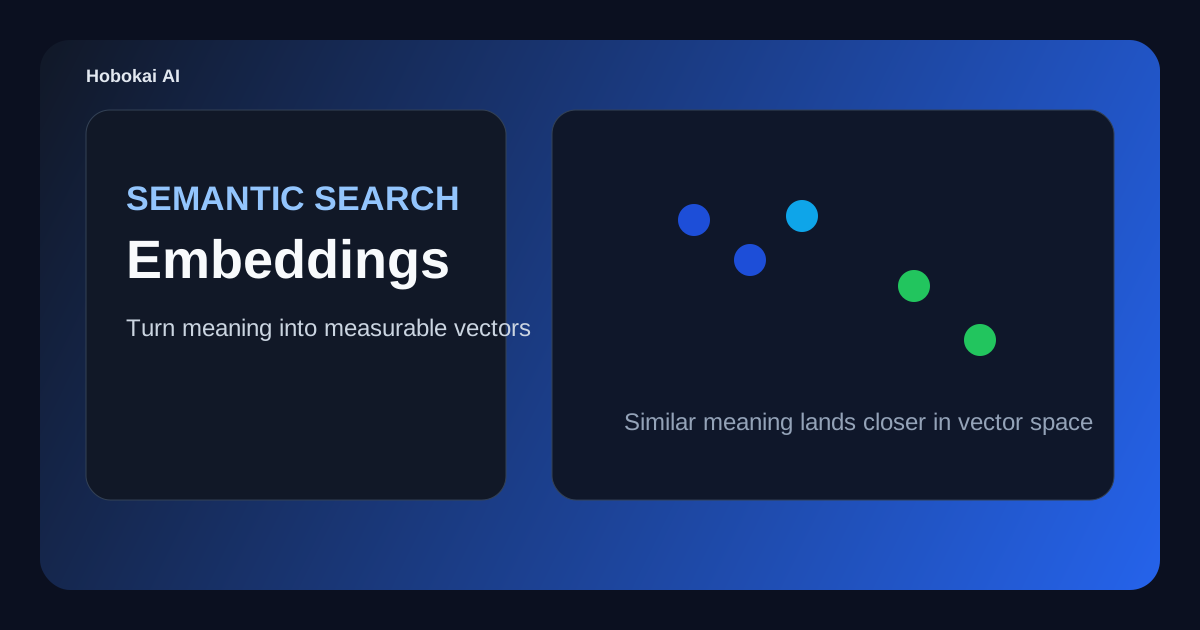
The important point is that embeddings are not just numeric encodings. They are vector representations that try to place semantically similar items closer together in a shared space.
This post covers three things.
- what embeddings are
- why text is turned into vectors
- how embeddings support search, recommendation, and RAG
The main idea is this: embeddings make semantic similarity measurable.
What embeddings are
An embedding is a fixed-length vector representation of data such as text, images, or items. The important part is that the vector tries to capture meaning-related relationships rather than acting like a random ID.
For example, “cat” and “dog” may land closer together than “cat” and “database” in embedding space.
Why text becomes vectors
Computers are not naturally good at comparing meaning from raw strings alone. Once text becomes vectors, systems can calculate things like:
- how similar two sentences are
- which document is closest to a question
- which items belong in a similar cluster
So embeddings turn meaning into something that can be computed on.
Where embeddings are used
1. Semantic search
Embeddings help retrieve documents that are similar in meaning even if the exact words differ.
Example:
- query: “forgot my password”
- document title: “how to reset your login password”
Exact wording differs, but semantic similarity can still be recognized.
2. Recommendation
Embeddings can help recommend items that are close in meaning or behavior to what a user already liked.
3. Clustering and classification
They are useful for grouping similar texts and building meaning-based organization layers.
4. RAG
In retrieval-augmented generation, embeddings often play a central role in finding documents relevant to the user query.
What it means for vectors to be close
This is one of the key intuitions to build early.
Each text becomes a vector, and distance or similarity between vectors becomes a proxy for semantic closeness.
So:
- close vectors -> likely similar meaning
- distant vectors -> likely less related meaning
It is not perfect understanding, but it is often extremely useful in search and retrieval systems.
How embeddings differ from keyword search
Keyword search usually focuses on exact or near-exact token matching. Embedding search is stronger when the wording differs but the meaning is similar.
That means:
- keyword search is strong for exact matches
- embedding search is strong for semantic similarity
In real systems, the two are often combined.
Common misunderstandings
1. Embeddings are just numeric IDs
No. The whole point is that their geometry carries meaningful similarity information.
2. Embeddings automatically make an LLM smarter
Not by themselves. They mainly help with representation and retrieval.
3. Embedding search is always better than keyword search
No. Exact matching still matters in many cases.
A good learning path
Embeddings usually make the most sense in this order:
That progression moves naturally from generation to retrieval-enhanced systems.
FAQ
Q. Are embeddings the same thing as an LLM?
No. They are related, but they are typically used more for representation and retrieval.
Q. If two texts have similar embeddings, are they guaranteed to mean the same thing?
Not guaranteed, but they are often closer in meaning than unrelated texts.
Q. Do I need embeddings for RAG?
In most semantic-retrieval-based RAG systems, embeddings are a core part of the workflow.
Read Next
- If you want to see how embeddings become part of a real AI retrieval system, continue with RAG Guide.
- If you want to compare retrieval with model adaptation, pair this with Fine-Tuning vs RAG Guide.
While AdSense review is pending, related guides are shown instead of ads.
Start Here
Continue with the core guides that pull steady search traffic.
- Middleware Troubleshooting Guide: Redis vs RabbitMQ vs Kafka A practical middleware troubleshooting guide for developers covering when to reach for Redis, RabbitMQ, or Kafka symptoms first, and which problem patterns usually belong to each tool.
- Kubernetes CrashLoopBackOff: What to Check First A practical Kubernetes CrashLoopBackOff troubleshooting guide covering startup failures, probe issues, config mistakes, and what to inspect first.
- Kafka Consumer Lag Increasing: Troubleshooting Guide A practical Kafka consumer lag troubleshooting guide covering what lag usually means, which consumer metrics to check first, and how poll timing, processing speed, and fetch patterns affect lag.
- Kafka Rebalancing Too Often: Common Causes and Fixes A practical Kafka troubleshooting guide covering why consumer groups rebalance too often, what poll timing and group protocol settings matter, and how to stop rebalances from interrupting useful work.
- Docker Container Keeps Restarting: What to Check First A practical Docker restart-loop troubleshooting guide covering exit codes, command failures, environment mistakes, health checks, and what to inspect first.
While AdSense review is pending, related guides are shown instead of ads.