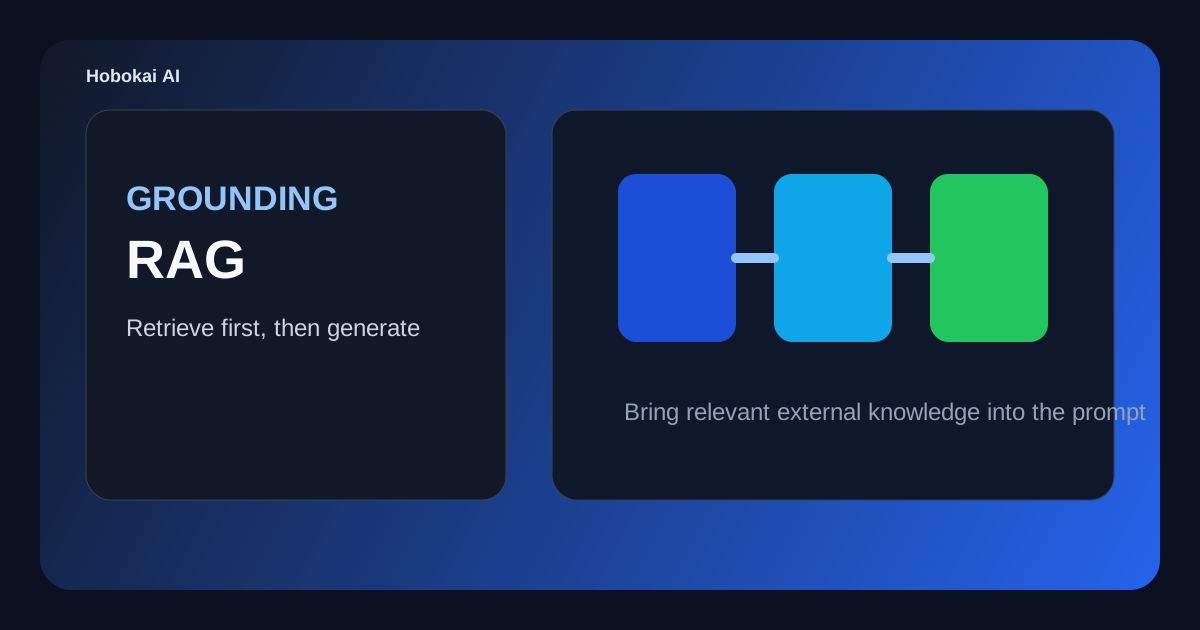
One of the fastest limits people hit with LLMs is this: the model may not know the latest information, may not know internal company documents, or may produce confident-sounding but wrong answers. One of the most common answers to that problem is RAG.
RAG improves generation by retrieving relevant outside documents and placing them into the model context before answering. That is why it appears so often in practical AI system design.
This post covers three things.
- what RAG is
- why it matters
- how retrieval, embeddings, and prompting work together
The key idea is this: RAG improves grounding by bringing useful external knowledge into the generation step.
What RAG is
RAG stands for Retrieval-Augmented Generation. In a simple version, it combines two stages:
- retrieve documents related to the question
- give those documents to the model while generating the answer
So instead of forcing the model to answer from memory alone, the system helps it read relevant material first.
Why RAG matters
LLMs are powerful, but they have a few visible limits:
- they may not reflect recent information
- they do not automatically know internal documents
- they can hallucinate plausible but wrong answers
RAG helps by attaching relevant supporting context without requiring the model itself to be retrained.
The most basic RAG flow
At a beginner level, this is usually enough:
- split documents into chunks
- create embeddings for those chunks
- embed the user query
- find the closest chunks
- place those chunks into the prompt and generate the answer
So RAG is really a retrieval-plus-generation architecture.
Why embeddings matter in RAG
Embeddings are what let the system compare the meaning of a query and the meaning of stored documents. That is why Embeddings Guide is such a natural companion topic here.
Without embeddings, meaning-based retrieval is much harder.
How prompting fits into RAG
Finding documents is not enough by itself. The model still needs a good prompt structure so it uses the retrieved material properly.
For example, a prompt can instruct the model to:
- answer only from the provided documents
- say “I do not know” if the documents are insufficient
- cite the supporting source
So RAG quality depends on retrieval quality and prompt design together.
Why RAG helps reduce hallucination
If the model can read grounded external material before answering, it is less likely to rely only on vague internal continuation patterns. Hallucination does not disappear completely, but grounded answers become much easier to encourage.
That is why RAG is so common in:
- internal document Q&A
- product documentation assistants
- policy and knowledge-base bots
- domain-specific support tools
Why RAG is not magic
This is important for beginners.
RAG does not automatically fix everything.
For example:
- if the retrieved document is wrong, the answer can still be wrong
- if chunking is poor, the important context may be missed
- if the prompt is weak, the model may not use the retrieved context well
So RAG helps structurally, but quality still depends on retrieval, document preparation, and prompting.
Common misunderstandings
1. RAG is just another name for fine-tuning
They overlap in goals sometimes, but they solve different problems.
2. Adding retrieval automatically makes answers correct
Not if the retrieval quality or source quality is poor.
3. RAG only matters for recent information
Recent information is one use case, but internal documents and domain grounding are just as common.
FAQ
Q. Should I think about RAG before fine-tuning?
For many knowledge-grounding problems, yes.
Q. Do I always need a vector database for RAG?
Not always in tiny demos, but it is very common in real systems.
Q. Is RAG only for chatbots?
No. It is also useful in assistants for summarization, analysis, search, and document workflows.
Read Next
- If you want to compare when retrieval is the right answer versus model adaptation, continue with Fine-Tuning vs RAG Guide.
- If you want an implementation-oriented example, pair this with the existing Supabase RAG Chatbot Guide.
While AdSense review is pending, related guides are shown instead of ads.
Start Here
Continue with the core guides that pull steady search traffic.
- Middleware Troubleshooting Guide: Redis vs RabbitMQ vs Kafka A practical middleware troubleshooting guide for developers covering when to reach for Redis, RabbitMQ, or Kafka symptoms first, and which problem patterns usually belong to each tool.
- Kubernetes CrashLoopBackOff: What to Check First A practical Kubernetes CrashLoopBackOff troubleshooting guide covering startup failures, probe issues, config mistakes, and what to inspect first.
- Kafka Consumer Lag Increasing: Troubleshooting Guide A practical Kafka consumer lag troubleshooting guide covering what lag usually means, which consumer metrics to check first, and how poll timing, processing speed, and fetch patterns affect lag.
- Kafka Rebalancing Too Often: Common Causes and Fixes A practical Kafka troubleshooting guide covering why consumer groups rebalance too often, what poll timing and group protocol settings matter, and how to stop rebalances from interrupting useful work.
- Docker Container Keeps Restarting: What to Check First A practical Docker restart-loop troubleshooting guide covering exit codes, command failures, environment mistakes, health checks, and what to inspect first.
While AdSense review is pending, related guides are shown instead of ads.